Overview
Android UI design patterns provide standardized solutions to common interface and interaction challenges in mobile applications. These patterns help developers and designers create consistent, intuitive, and scalable user interfaces. By applying established design patterns, applications offer improved usability, maintainability, and visual clarity across a range of device sizes and interaction contexts.
This documentation explains key Android UI design patterns that are widely used in real-world applications.
Model-View-Controller (MVC) Pattern
The MVC pattern separates an application into three interconnected components:
- Model: Represents data and business logic
- View: Handles UI rendering and user interaction
- Controller: Processes input and updates model and view
In Android, activities and fragments frequently act as controllers, views are XML layouts, and models represent data entities. Proper separation of concerns helps in isolating UI logic from business logic.
Model-View-ViewModel (MVVM) Pattern
MVVM is a variant of MVC adapted for modern reactive UI frameworks. It separates:
- Model: Data and domain logic
- View: UI elements
- ViewModel: Handles state and exposes observable data for the view
In Android development, MVVM is frequently implemented with LiveData, ViewModel, and Data Binding from Android Jetpack libraries. This enhances testability and reduces boilerplate code.
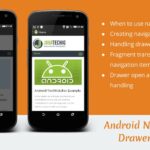
Navigation Drawer Pattern
The Navigation Drawer pattern provides a consistent way to access top-level application destinations.
Key Characteristics
- Sliding panel from the left edge
- Contains navigation options
- Typically activated by an icon in the toolbar
Navigation Drawer is appropriate for applications with multiple major sections that do not fit comfortably in bottom navigation.
Bottom Navigation Pattern
Bottom navigation displays primary destinations across the bottom of the screen. It is recommended for applications with 3–5 top-level views.
Best Practices
- Use concise labels and icons
- Maintain consistency with platform design guidelines
- Do not overload with too many items
Master-Detail Pattern
The Master-Detail pattern is used to display a list (master) and detailed view (detail) simultaneously on larger displays, such as tablets.
Behavior
- On phones: Master and detail views transition between screens
- On tablets: Both views appear side by side
This pattern enhances efficiency by reducing navigation steps for users.
Card UI Pattern
The Card UI pattern organizes information into visually distinct components called cards. Each card serves as a container for related content such as text, images, and actions.
Advantages
- Improves scannability
- Supports adaptable layouts
- Works well with RecyclerView
Card patterns are commonly used in feeds, dashboards, and summary lists.
RecyclerView & Adapter Pattern
RecyclerView is a flexible and efficient view for displaying large datasets. It relies on the ViewHolder and Adapter pattern:
- Adapter: Binds data to view items
- ViewHolder: Caches views for improved performance
RecyclerView supports:
- Linear and grid layouts
- Item animations
- Efficient recycling of view objects
Responsive Layout Pattern
Responsive layouts ensure a seamless experience on devices with varying screen sizes and orientations.
Techniques
- Use ConstraintLayout for complex, flexible designs
- Provide layout-resource qualifiers (e.g.,
layout-sw600dp) - Test UI across different device profiles
Responsive design helps maintain visual consistency across phones and tablets.
Input & Form Pattern
Input patterns define how users interact with forms and data entry.
Key Elements
- Clear labels and hints
- Appropriate keyboard types (numeric, email)
- Inline validation for feedback
- Focus management for efficient navigation
Well-designed input forms reduce user errors and improve engagement.
Dialog & Alert Patterns
Dialogs help communicate critical information or prompt confirmation.
Types
- AlertDialog: Messages with actions
- ProgressDialog: Feedback during lengthy tasks
- BottomSheetDialog: Contextual menus or actions from bottom edge
Use dialogs judiciously to avoid interrupting user flow unnecessarily.